Discover Musical Instruments on Amazon

Musical instruments banner

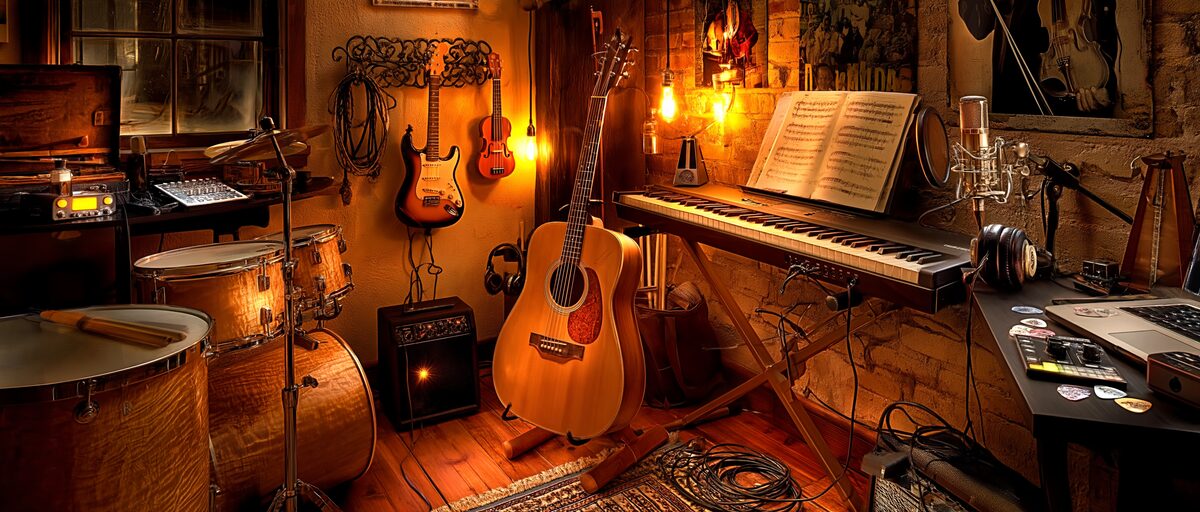
Musical instruments is one of the most exciting departments on Amazon, covering everything from a first acoustic guitar or a child's recorder to professional studio microphones, digital pianos with weighted keys, and complete home recording setups. Whether you are picking up an instrument for the first time, returning to music after years away, upgrading your gear, or equipping a home studio, the range available spans every instrument family, every skill level, and every budget.

This page organises more than thirty categories of musical instruments and equipment into clear sections โ€” guitars, keyboards and piano, drums and percussion, orchestral strings, woodwind, brass, folk instruments, recording and studio gear, live sound, and essential accessories. Each button routes you directly to the relevant section of your local Amazon store.

Between the product sections you will find practical articles with honest advice about choosing instruments, understanding what matters at different stages of your musical journey, and avoiding the most common mistakes buyers make. Use the search bar above to find something specific, or browse by department below.

Disclosure: This site participates in the Amazon Associates Programme. As an Amazon Associate we earn from qualifying purchases. This helps support our free versions of the Memory Cube app - an interactive 3D photo and video display, with lightbox and online jigsaw puzzle game.

Shop Musical Instruments on Amazon

Guitars, keyboards, drums, orchestral strings, woodwind, brass, folk instruments, recording gear, live sound and accessories

Digital pianos, keyboards, synthesisers, MIDI controllers, drums and percussion

Orchestral strings, woodwind, brass and folk instruments

Recording, studio gear, live sound, accessories and learning resources

Guitars

Acoustic, classical, electric and bass guitars, amplifiers, effects pedals and accessories

Choosing Your First Instrument: What Nobody Tells You

The decision to learn a musical instrument is one of the most rewarding choices a person can make at any age. But the excitement of that decision often collides with a bewildering marketplace, and the instrument you choose โ€” and the quality of that instrument โ€” can mean the difference between a lifelong passion and a dusty case in the attic within six months.

The most important piece of advice is also the simplest: choose the instrument whose sound moves you. Not the instrument your parents played, not the one your friend recommends, not the one that seems most practical or most impressive. If the sound of a saxophone makes your heart lift every time you hear it, that emotional connection will carry you through the frustrating early months when your fingers will not cooperate and the sounds you produce bear little resemblance to the music in your head. Motivation fuelled by genuine love of an instrument's voice is far more durable than motivation driven by logic alone.

The second consideration is physical. Instruments have real physical demands that vary considerably. A full-sized acoustic guitar requires hand span and finger strength that a small child or someone with hand mobility issues may find prohibitive โ€” a ukulele, a half-size guitar, or a keyboard might be a better starting point. Wind instruments require breath control and, in the case of brass, the development of an embouchure (the specific use of facial muscles and lips) that takes weeks to months before reliable sound production becomes possible. String instruments like the violin demand precise finger placement without frets to guide you, making the initial learning curve steeper than fretted instruments.

The Instrument Quality Trap

Here is where many beginners go wrong. The very cheapest instruments โ€” those sold at impossibly low prices that seem too good to be true โ€” almost invariably are. A guitar with an action so high that pressing strings to the fretboard causes hand pain is not a beginner-friendly instrument; it is an instrument that will teach you to associate playing with discomfort. A keyboard with unweighted keys that feel nothing like a real piano will build habits that need to be unlearned later. A violin that cannot hold its tuning will sound terrible regardless of technique, and the student will blame themselves rather than the instrument.

This does not mean spending a fortune. The sweet spot for a first instrument lies in the entry-level range from established musical instrument brands โ€” companies that understand what a beginner needs and engineer their affordable instruments accordingly. These instruments play in tune, stay in tune, feel comfortable in your hands, and sound good enough to be encouraging rather than discouraging. The difference between this tier and the absolute cheapest option is typically modest in price but enormous in experience.

Renting Before Buying

For orchestral instruments especially โ€” violins, cellos, flutes, clarinets, trumpets โ€” renting is a genuinely excellent option for the first year. Rental programmes allow you to discover whether you connect with the instrument before committing to a purchase, and for children, they solve the practical problem of needing progressively larger instruments as the player grows. Many rental agreements allow the fees paid to contribute toward an eventual purchase, making the financial logic compelling.

Keyboards & Piano

Digital pianos, keyboards, synthesisers and MIDI controllers

Drums & Percussion

Acoustic drum kits, electronic drums and hand percussion

Practice: The Uncomfortable Truth About Getting Better

Every musician, from the absolute beginner to the concert professional, shares a common experience: the gap between what they hear in their imagination and what their hands can produce. Closing that gap is the work of practice, and understanding how practice actually works โ€” as opposed to the myths surrounding it โ€” can save you years of frustration.

The popular notion that mastery requires ten thousand hours of practice has entered public consciousness as a kind of law of nature. But the original research this figure comes from was far more nuanced than the headline suggests. The quality of practice matters enormously more than the quantity. A focused thirty-minute session where you isolate a specific difficulty, work through it slowly, and gradually increase the tempo until it flows naturally will achieve more than three hours of mindlessly playing through pieces you already know. The first is practice; the second is merely playing.

This distinction matters because it transforms the time commitment from daunting to manageable. You do not need hours of free time each day to make meaningful progress on a musical instrument. What you need is consistency โ€” regular, focused sessions where you work specifically on the things you cannot yet do. Twenty minutes of genuine practice five days a week will produce better results than a single marathon session at the weekend, because your brain consolidates motor learning during sleep. Each practice session plants seeds; overnight rest is when they grow.

The Plateau Problem

Every musician encounters plateaus โ€” periods where progress seems to stall despite continued effort. These are not signs of limited talent. They are a normal, predictable feature of skill acquisition. Your brain is consolidating and reorganising the skills you have built so far, preparing the neural foundations for the next level of ability. The musicians who push through plateaus โ€” sometimes by changing their approach, sometimes by simply persisting with patience โ€” are the ones who eventually achieve the fluency they aspire to.

Playing With Others

Perhaps the single most powerful accelerator of musical development is playing with other people. Whether it is a formal ensemble, a casual jam session, a duet with a teacher, or simply playing along with recordings, the experience of making music collaboratively develops skills that solitary practice cannot. You learn to listen while playing. You develop a sense of timing relative to other musicians. You discover how your instrument fits within a larger sound. And, critically, you experience the unique joy of shared music-making โ€” a reward that sustains motivation far more effectively than any practice schedule.

Orchestral Strings

Violins, cellos, double basses and accessories

Woodwind

Flutes, clarinets, oboes, saxophones, recorders and harmonicas

Brass Instruments

Trumpets, trombones, French horns, tubas and accessories

Digital Versus Acoustic: An Honest Comparison

The choice between digital and acoustic instruments is one of the most debated topics in music, and much of the debate generates more heat than light. The truth is that both have genuine strengths, and the right choice depends on your circumstances, your goals, and your living situation far more than it depends on which is "better" in some abstract sense.

Acoustic instruments offer an authenticity of sound and physical response that digital technology has narrowed but not entirely closed. The resonance of an acoustic guitar's wooden body, the complex overtones of a grand piano's strings, the physical vibration of a drum kit played with real sticks โ€” these are sensory experiences that connect the player to the instrument in a direct, visceral way. There is no latency, no sampling, no electronic interpretation between your action and the sound produced. For many musicians, this directness is fundamental to the joy of playing.

Digital instruments counter with compelling practical advantages. A digital piano with headphones allows practice at any hour without disturbing neighbours or family members โ€” a consideration that, for many people in shared housing or flats, is not a convenience but a necessity. Electronic drum kits reduce volume by orders of magnitude compared to their acoustic counterparts, making home practice genuinely feasible where it would otherwise be impossible. Digital pianos never need tuning, are not affected by temperature or humidity, and weigh a fraction of their acoustic equivalents.

The Quality Gap Has Closed Dramatically

Modern digital pianos with weighted, hammer-action keys now feel remarkably similar to acoustic pianos under the fingers. The sound, sampled from world-class concert instruments and reproduced through carefully voiced speakers, is genuinely beautiful. For a pianist who primarily plays at home, a quality digital piano at a fraction of the cost of an upright acoustic may be the more sensible choice โ€” particularly when factoring in the ongoing cost of professional tuning that acoustic pianos require at least twice yearly.

Where Acoustic Remains King

For instruments where the physical interaction between player and instrument is central to the sound โ€” violin, cello, acoustic guitar, all wind and brass instruments โ€” there is no meaningful digital equivalent for serious study. A breath-controlled synthesiser is not a clarinet. A MIDI guitar is not an acoustic guitar. The techniques, the muscle memory, and the subtle control that define these instruments are inseparable from their physical form. In these categories, the choice is not digital versus acoustic โ€” it is which acoustic instrument represents the best value for your level.

Folk & Other Strings

Ukuleles, mandolins, banjos and folk string instruments

Recording & Studio

Audio interfaces, microphones, studio monitors, headphones and home recording equipment

Home Recording: What You Actually Need to Get Started

The democratisation of music recording is one of the genuine revolutions of the past two decades. Equipment that once required a professional studio and a significant budget is now available to anyone with a computer and a modest investment. But the sheer variety of recording gear available can be paralysing, and the marketing around it often implies you need far more than you do.

A functional home recording setup requires four things: a computer (which you almost certainly already own), an audio interface (the device that converts analogue sound into digital data your computer can work with), a microphone, and a pair of headphones or studio monitors for playback. That is genuinely all you need to record, edit, and produce music at a quality that would have been unattainable outside a professional facility a generation ago.

The audio interface is the heart of the system, and it is worth understanding what it does. Your computer's built-in sound hardware is designed for general-purpose audio โ€” video calls, music playback, system sounds. It introduces latency (a perceptible delay between playing a note and hearing it back), has limited input quality, and lacks the connections needed for professional microphones. An audio interface solves all three problems, providing low-latency monitoring, high-quality analogue-to-digital conversion, and proper microphone inputs with phantom power for condenser microphones.

The Microphone Decision

For most home recording purposes, a single large-diaphragm condenser microphone will cover an impressively wide range of applications โ€” vocals, acoustic guitar, piano, and many other sources. These microphones are sensitive and detailed, capturing nuance that dynamic microphones (the type you see on live stages) are designed to ignore. Entry-level condenser microphones have improved enormously, and the results achievable with current budget models would have been considered very good indeed by professional standards not so long ago.

The Room Matters More Than the Gear

Here is the insight that separates experienced home recordists from beginners: the acoustics of your room affect your recordings far more than the quality difference between a mid-range and a premium microphone. A bare room with hard walls, floors, and ceilings creates reflections that colour every recording with an unflattering, boxy quality. Simple acoustic treatment โ€” even makeshift solutions like recording in a room with soft furnishings, hanging blankets behind the microphone, or using a portable vocal booth โ€” can improve your sound quality more dramatically than any equipment upgrade. Address the room first, then worry about upgrading your gear.

Live Sound

PA systems, powered speakers and stage equipment

Accessories & Learning

Tuners, metronomes, instrument cases, care products and learning resources

Learning an Instrument as an Adult: Why It Is Different and Why That Is Fine

There is a deeply ingrained cultural assumption that musical instruments should be learned in childhood โ€” that the window for developing musical ability closes somewhere around the age of twelve, and that adults who take up an instrument are engaged in a charming but ultimately futile hobby. This assumption is wrong, and understanding why it is wrong can liberate anyone who has ever wanted to play but felt the moment had passed.

Children do have certain neurological advantages when learning instruments. Their brains are in a period of rapid development, forming neural connections with extraordinary speed. Their smaller hands sometimes suit scaled-down instruments well. And crucially, they have time โ€” years of regular lessons and practice stretching ahead of them, often supported by school music programmes and parental encouragement.

But adults have advantages that are rarely acknowledged. You can understand music theory conceptually in ways that young children cannot, allowing you to grasp chord relationships, key signatures, and rhythmic structures through intellectual understanding rather than rote memorisation. You can direct your own learning, choosing music that motivates you rather than working through a prescribed syllabus. You have life experience that enriches your interpretation of music โ€” the emotional depth you bring to a piece as an adult adds something that technical proficiency alone cannot provide.

Different Goals, Different Measures

Perhaps most importantly, adult learners can define their own success. A child's musical education is often measured against external standards โ€” exams, competitions, orchestral auditions. An adult who learns guitar to play songs around a campfire, or takes up piano to work through favourite pieces at their own pace, or discovers the meditative pleasure of a daily flute practice, has succeeded the moment the instrument brings them joy. There is no standard to meet, no audience to impress, and no deadline to reach.

The practical barriers โ€” time, self-consciousness, stiff fingers โ€” are real but manageable. Short, consistent practice sessions fit around busy lives more easily than the hour-long sessions often prescribed for children. Playing alone in your own home removes the self-consciousness that many adults feel. And while adult hands may be less flexible than a child's, they are stronger and more coordinated, advantages that compensate in different ways across different instruments.

The Joy Is in the Journey

The musicians who derive the most lasting satisfaction from their playing โ€” at any age โ€” are those who find pleasure in the process of learning itself. Every new chord learned, every piece that gradually comes together under your fingers, every moment where you lose yourself in the sound you are creating represents a small, genuine achievement. Music does not require an audience, a stage, or a qualification to be meaningful. It requires only your attention, your time, and an instrument that responds to your touch.

Ready to play?

You've Found the Inspiration.
Now Find Your Instrument.

Thousands of musical instruments and accessories across more than thirty categories โ€” guitars, pianos, drums, orchestral instruments, recording gear and more โ€” all ready to browse on Amazon.

Free delivery options available Deals change daily โ€” today's won't last Trusted by millions of shoppers worldwide